heating guide
How Much Does It Cost to Heat a Garage?
Calculate garage heating cost from heater input, runtime, local energy prices, efficiency, insulation, air leakage, and how you use the space.
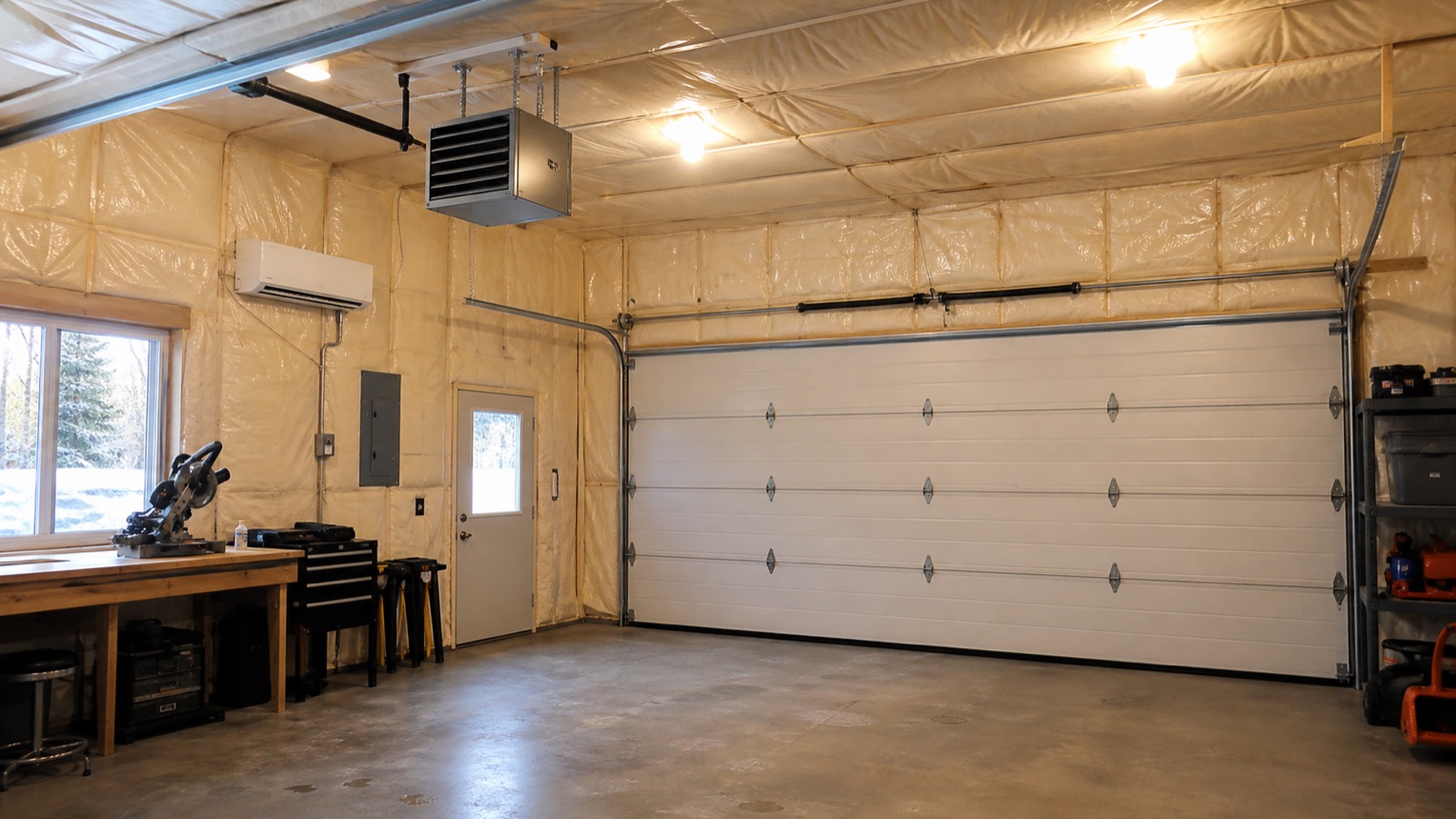
The cost to heat a garage depends on four things: the heater’s energy input, how long it runs, your local energy price, and how much heat the garage loses. For an electric resistance heater, the quickest estimate is:
Hourly cost = heater input in kilowatts × electricity price per kilowatt-hour
A 5 kW heater at a hypothetical electricity rate of $0.18/kWh costs $0.90 per hour while its heating elements are energized. It will not necessarily draw full power continuously after the space reaches its setpoint, so a monthly estimate also needs a realistic duty cycle.
Quick electric-heater examples
The table below uses an illustrative rate of $0.18/kWh, not a national average or a quote for your property. Replace it with the total per-kWh rate shown on your bill.
| Heater input | Cost per energized hour | Cost for 4 energized hours | Cost for 8 energized hours |
|---|---|---|---|
| 1.5 kW | $0.27 | $1.08 | $2.16 |
| 5 kW | $0.90 | $3.60 | $7.20 |
| 7.5 kW | $1.35 | $5.40 | $10.80 |
These figures are energy costs only. They do not include equipment, installation, electrical upgrades, maintenance, taxes that are not included in your entered rate, or fixed utility charges you would pay anyway.
Estimate a month, not just an hour
Use this formula for a resistance heater:
Monthly cost = input kW × hours used per day × days used × duty cycle × $/kWh
Suppose the 5 kW heater is used for four hours on 12 workshop days. If it averages a 60% duty cycle after warm-up, the estimate is:
5 × 4 × 12 × 0.60 × $0.18 = $25.92 per month
Duty cycle is the fraction of the session during which the heater is actually drawing its rated heating power. A heater running without interruption has a 100% duty cycle. A thermostat cycling it on for roughly half the session gives about 50%. Plug-in energy monitoring can help with suitable 120-volt appliances, but meters and receptacles must be rated for the continuous load. For hardwired equipment, use its controls or a qualified electrician’s measurement rather than improvising at the panel.
Compare fuels by useful heat
Comparing one gallon of propane with one kilowatt-hour of electricity tells you little because they contain different amounts of energy. The U.S. Energy Information Administration recommends comparing heating fuels on a common heat-content basis, such as dollars per million Btu.
EIA’s standard conversions include:
- 1 kWh of electricity = 3,412 Btu
- 1 therm of natural gas = 100,000 Btu
- 1 U.S. gallon of propane = 91,452 Btu
Then account for equipment efficiency. The useful-heat cost is:
Fuel price ÷ energy in that sales unit ÷ seasonal efficiency
Here is a purely illustrative comparison. It assumes electricity at $0.18/kWh, natural gas at $1.50/therm, propane at $2.50/gallon, 80% fuel-burning efficiency, and a heat-pump coefficient of performance (COP) of 3.0.
| Heating method | Assumption | Approximate cost per million Btu of useful heat |
|---|---|---|
| Electric resistance | $0.18/kWh | $52.75 |
| Heat pump | $0.18/kWh, COP 3.0 | $17.58 |
| Natural gas | $1.50/therm, 80% | $18.75 |
| Propane | $2.50/gallon, 80% | $34.17 |
This is a calculation example, not a promise that one system will be cheapest at your garage. Fuel delivery charges, minimum purchases, standby losses, defrost, outdoor temperature, part-load performance, and maintenance can change the result. Use local prices and the equipment’s rated performance at your winter conditions.
Heat pumps move heat rather than creating it through resistance. The Department of Energy says current heat pumps can reduce electricity use for heating by up to 75% compared with electric resistance heating. Actual garage savings vary, particularly during cold starts and low outdoor temperatures. Compare capacity and efficiency at the design temperature, not only the headline seasonal rating.
Why two similar garages can have different bills
Floor area alone does not determine operating cost. Heat escapes through the garage door, walls, ceiling, windows, slab edges, and air leaks. Opening a large door can replace much of the warmed air in minutes. A detached, uninsulated garage in a windy climate can therefore cost far more to maintain than the same-size insulated garage sheltered by a house.
The target temperature matters too. Freeze protection, a cool working temperature, and living-room comfort are different jobs. Increasing the indoor-to-outdoor temperature difference increases heat loss. Intermittent use can reduce total hours, but each session must also warm the slab, tools, vehicles, and other cold mass.
Before choosing equipment, use the garage heater sizing guide and heater-size estimator to develop a plausible load range. If the garage is unfinished, see the guide to heating an uninsulated garage. Our electric-versus-propane comparison covers practical tradeoffs beyond fuel price.
A better way to forecast your cost
- Copy the all-in variable energy rate from recent bills. Use winter rates where pricing changes by season or time of day.
- Record the heater’s input, not its advertised output. For heat pumps, use performance data at relevant outdoor temperatures.
- Estimate weekly sessions, warm-up time, setpoint, and duty cycle.
- Calculate a low and high case rather than one precise-looking number.
- Compare the estimate with actual bills or metered consumption, then revise the duty-cycle assumption.
For example, test 40%, 70%, and 100% duty cycles. This exposes the uncertainty and shows how much insulation, air sealing, or a lower setpoint could matter.
Safety and installation costs belong in the decision
Do not choose a fuel-burning heater on operating cost alone. Combustion equipment introduces venting, combustion-air, clearance, fuel-storage, and carbon-monoxide requirements. The CPSC warns against using portable fuel-burning camping equipment in a home, garage, vehicle, or tent unless it is specifically designed and instructed for enclosed-space use. Follow the appliance manual and local code; have permanent gas and electrical work designed and installed by qualified professionals.
Never run a vehicle or portable generator in a garage, even with the main door open. Provide appropriate carbon-monoxide alarms where required, but do not treat an alarm or an open door as permission to misuse combustion equipment.
The lowest responsible heating cost usually comes from matching the system to the actual load, reducing avoidable heat loss, and heating the garage only to the temperature and schedule the work requires.