ventilation guide
Garage Exhaust-Fan Sizing Guide
Estimate garage exhaust airflow from room volume, contaminant source, replacement air, duct resistance, and fan performance.
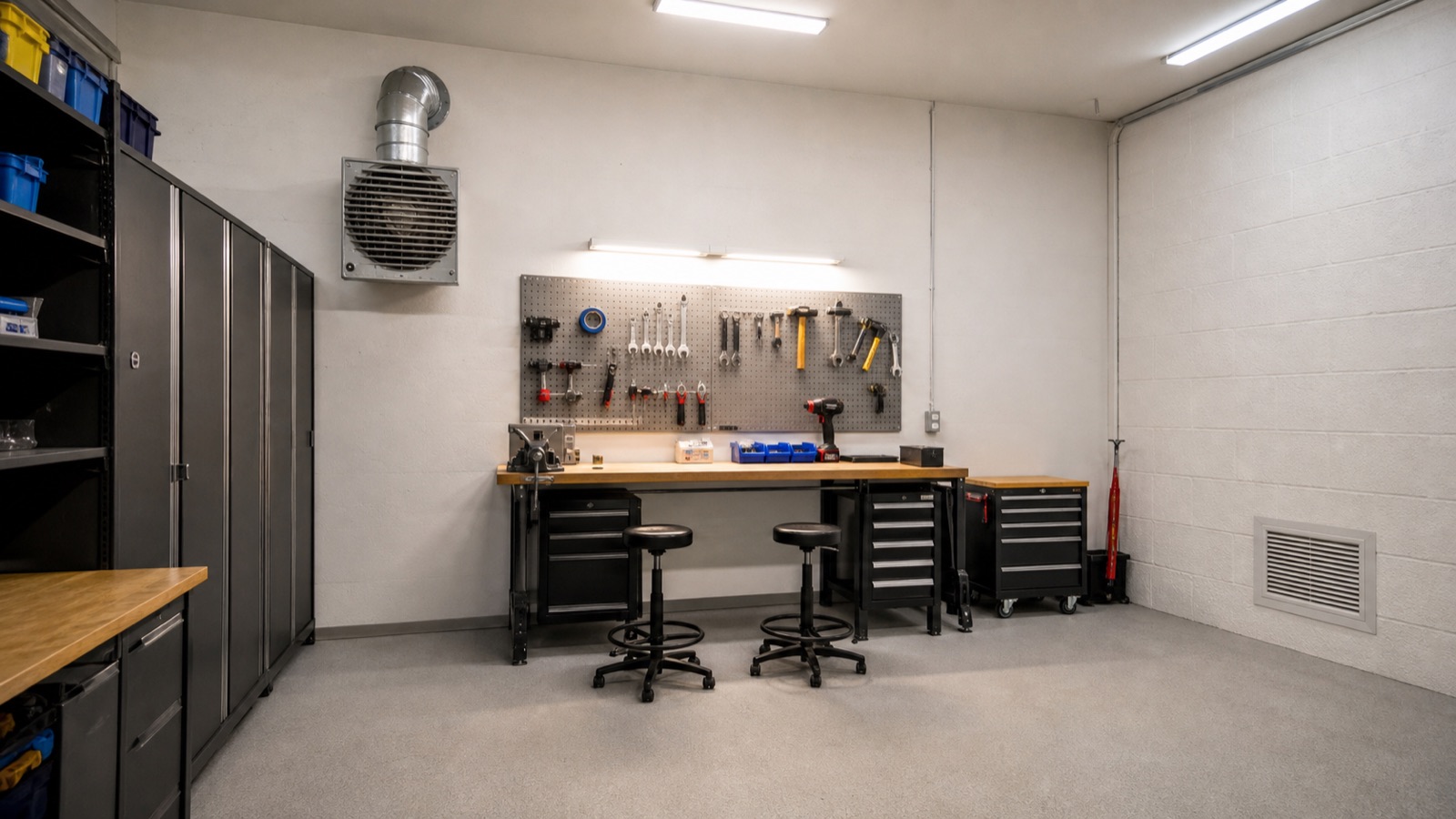
Air changes are only a starting point
Multiplying room volume by a target air-change rate yields free-air cubic feet per minute, but it does not prove contaminant control. Source capture depends on hood geometry, distance, cross-drafts, and the substance being controlled. The fan must also overcome duct, grille, damper, and filter resistance.
Sizing sequence
- Identify contaminants and whether source capture is required.
- Calculate room volume and a background-airflow target.
- Design a low-resistance discharge route and deliberate intake.
- Read the fan curve at expected static pressure—not the box’s free-air number.
- Commission the system by measuring airflow and checking pressure relationships.
Hazardous fumes, flammable vapor, and combustible dust require specialist assessment. Generic air-change guidance is not a safe substitute.